Group pricing
- Price per person for the group
- $75.65
- What the group pays
- $907.80
- What the group costs you
- $536
- Contribution after the departure's own cost
- $371.80
Every figure on these worksheets is one you typed. Where a page states something outside your own book, it names the document it came from and the day it was read.
The figures open on a worked example ($75.65) from a small operator's own book. Change any of them and the answer moves as you type.
Download the Group pricing worked example (CSV)
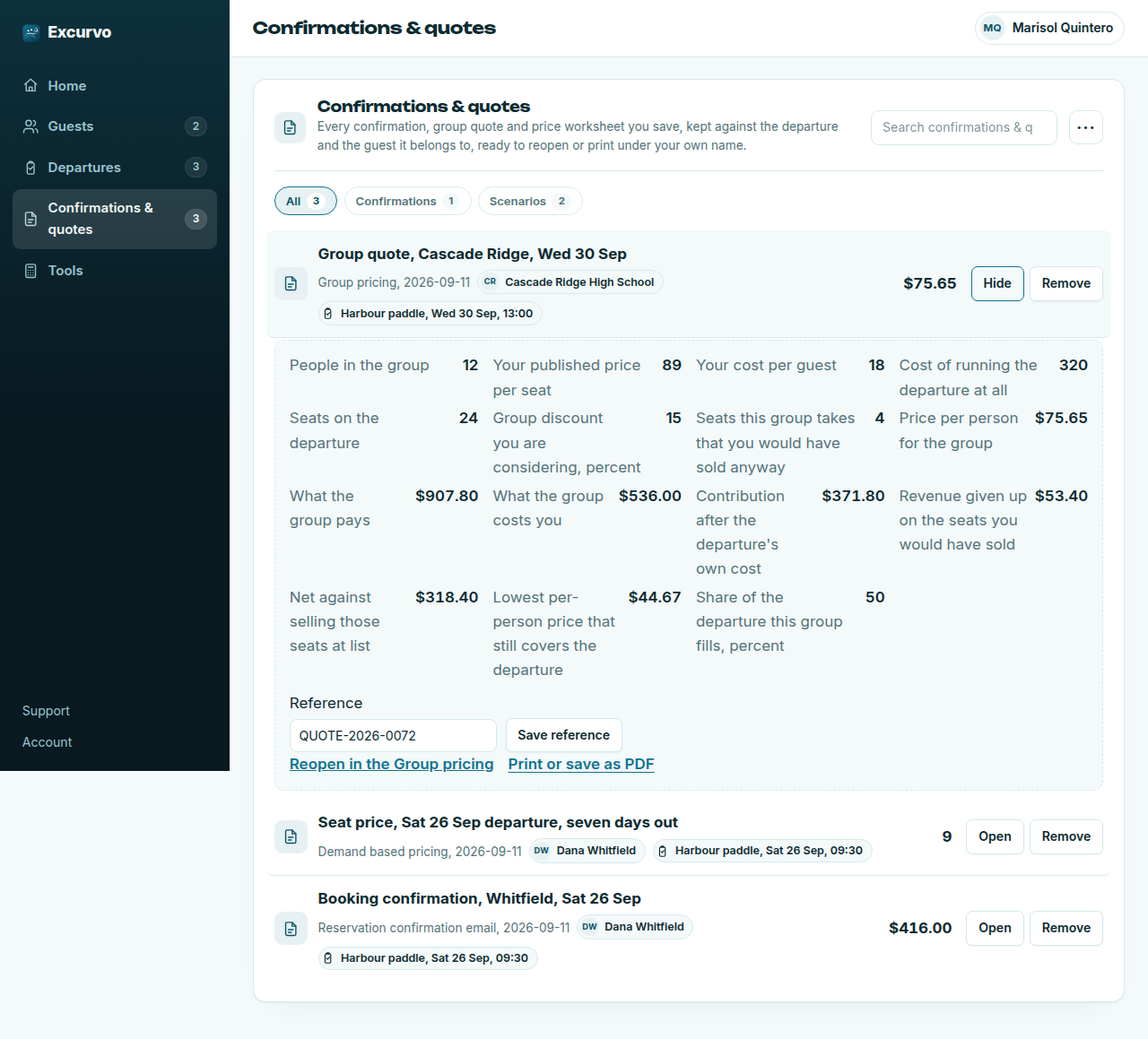
This worksheet answers the group enquiry: what to charge twelve people who want a departure at a discount, and whether that discount leaves anything behind. It takes the group size, your published price, your cost per guest, what the departure costs to run at all, the capacity, the discount you are considering and, crucially, how many of those seats you would have sold anyway. It returns the per-person price, what the group pays, what it costs you, the revenue you gave up on the seats that were never going to be empty, and the lowest price that still covers the trip.
What operators ask about the Group pricing
How big a group discount can I afford? It depends almost entirely on one number this page asks for and most quotes ignore: how many of those seats would have sold anyway. A group that fills seats which were going to leave empty can take a deep discount and still be the best sale of the week. A group that displaces full-price bookings is paying you less for seats you already had a buyer for, and the worked example prices that difference explicitly.
Should the group price include the fixed cost of the departure? Yes, if the group is the reason the departure runs, and no, if it is joining one that was running regardless. The breakeven line on this page is worked the first way, which is the cautious one: it spreads the whole cost of running the trip across the group alone, so the number it gives you is a floor you can quote from without checking anything else.
Why does the worksheet ask for my cost per guest separately? Because the cost of carrying one more person and the cost of running the departure behave completely differently, and a group quote that mixes them up is the most common way operators lose money politely. Fuel, entry fees and equipment scale with heads; the guide, the vehicle and the slot do not.
Where the constants in this tool come from
Seller of Travel, California Attorney General. What a business selling travel in California must register, disclose and do with money taken in advance, including the trust-account and refund obligations on deposits. Read 2026-09-11.
46 CFR Part 176, Inspection and Certification (Legal Information Institute, Cornell Law School). Where a small passenger vessel's capacity number actually comes from: the certificate of inspection, not the operator's preference. Read 2026-09-11.